Content Orchestration: The 6-Step System We Use
The exact 6-step content orchestration system we run across luxury brands. From brand folder to reporting — what to publish, where, and why.

On this page
- Introduction
- TL;DR: The 6-Step Content Orchestration System
- How We Evaluated Each Step
- Content Orchestration System Comparison Table
- 1. Brand Folder: The Single Source of Truth
- 2. Research: Deep Industry, Competitor, and Topic Intelligence
- 3. Strategy: Two Questions That Decide Everything
- 4. Content Orchestration: Omnipresence Across Channels
- 5. Data Intelligence: Enriching Live Lead Intake With AI
- 6. Reporting: Monthly Visibility Across Every Channel
- How to Choose Where to Start With Content Orchestration
- Frequently Asked Questions
Introduction
Most brands treat content orchestration like a posting habit, not a system. They publish on one channel, miss weeks at a time, and end up with disconnected blog posts, social posts, and ideas that never build on each other.
This article breaks down the exact 6-step system used across a portfolio of luxury brands with AI: brand folder, research, strategy, orchestration, data intelligence, and reporting. Step 1 is the foundation, step 6 closes the loop, and the order matters because each stage feeds the next rather than running as separate marketing tasks.
TL;DR: The 6-Step Content Orchestration System
Content orchestration verdict: the brand folder is the foundation, AI-powered research and strategy decide what to publish, and orchestrated distribution plus data intelligence and reporting compound results over time. For the full guide, see our organic growth system.
- For brand consistency at scale: Step 1, the brand folder
- For knowing what to publish: Step 2, research
- For deciding where to focus: Step 3, strategy
- For omnipresence across channels: Step 4, orchestration
- For sharpening what works: Step 5, data intelligence
- For making the loop visible: Step 6, reporting
How We Evaluated Each Step
These are the 5 criteria applied to every step in the system below. Each step section is measured against the same framework so the comparison stays consistent and practical.
Brand consistency at scale
This checks whether a step helps keep the same brand voice, positioning, and factual context across LLMs, channels, and team handoffs. If a step makes output drift between the website, LinkedIn, newsletter, or Facebook, it scores lower here.
AI leverage without losing voice
This looks at where AI should do the heavy lifting and where a human still needs to guide, review, or approve. A strong step saves time with automation, but it still protects the brand’s point of view, tone, and decision-making.
Channel coverage and omnipresence
This measures whether a step helps the brand show up where its ICP actually spends time, including the website, LinkedIn, Reddit, newsletter, and Facebook. A step scores higher if it improves coordinated presence across those surfaces instead of treating each channel as a separate job.
Data feedback loop
This checks whether a step produces useful data, uses existing data, or ideally does both. The stronger steps sharpen the next cycle by feeding performance signals, audience patterns, and content learnings back into research, strategy, and publishing.
Time to implement
This judges setup effort in realistic terms, not theory. Some steps can be put in place quickly, while others need more upfront work because they become the infrastructure the rest of the system depends on.
Content Orchestration System Comparison Table
This table gives a clean view of the 6-step system before the full breakdowns below. It compares each step on the same dimensions so you can quickly see what the step is for, what asset drives it, where it fits best, and what tradeoff comes with it.
| Step | Purpose | Primary Tool/Asset | Best For | Main Limitation |
|---|---|---|---|---|
| 1. Brand Folder | Lock brand context | Brand folder doc | Consistent voice across outputs | Setup takes a weekend |
| 2. Research | Find demand and angles | Claude Skills + research tools | Knowing what to publish | Only as good as inputs |
| 3. Strategy | Prioritize channels and topics | Internal strategy framework | Deciding where to focus | Needs clear business goals |
| 4. Content Orchestration | Turn plans into output | Multi-channel publishing stack | Coordinated channel presence | Drifts without source context |
| 5. Data Intelligence | Surface patterns from signals | AI-enriched lead intake | Sharpening what works | Weak if tracking is messy |
| 6. Reporting | Close the performance loop | Monthly performance report | Seeing progress clearly | Backward-looking by nature |
1. Brand Folder: The Single Source of Truth
Overview
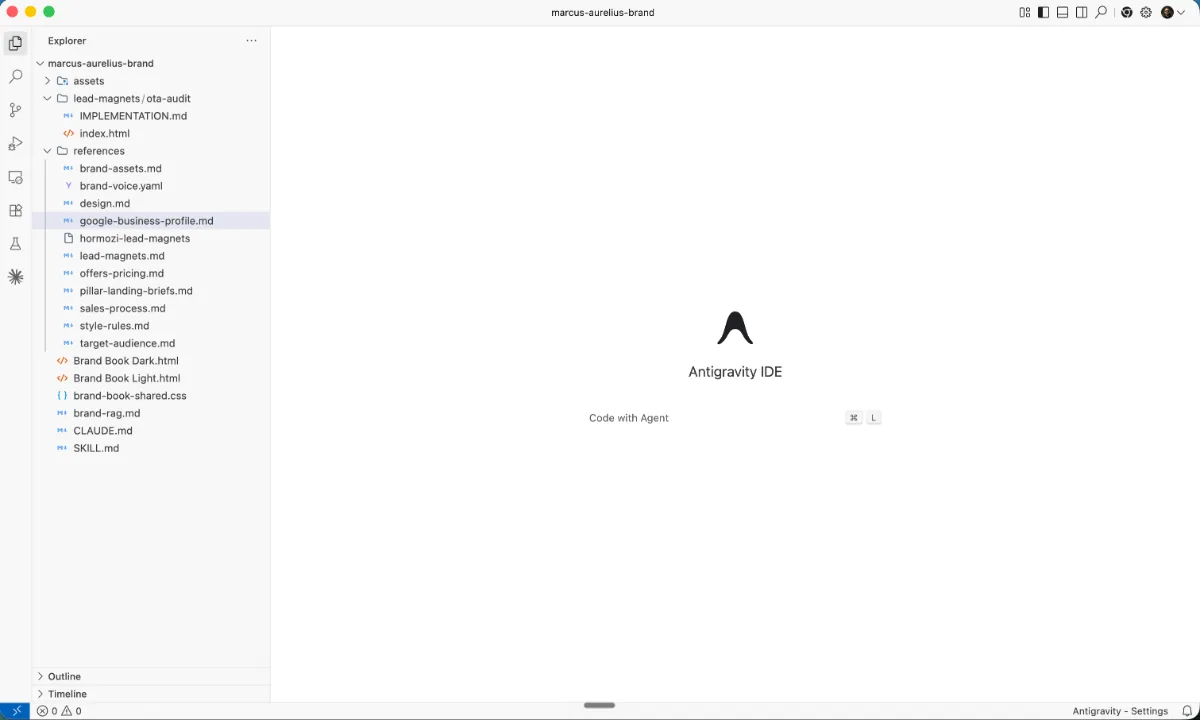
The brand folder is a single document that contains everything an LLM or team member needs to produce on-brand content every time.
It gives AI persistent context instead of forcing a fresh re-brief in every session. That matters because most brand drift starts when tools fill in missing details with defaults.
In practice, this is the foundation layer for everything that follows. If step 1 is weak, research gets generic, strategy gets fuzzy, and publishing starts to sound different from one channel to the next.
What goes inside the brand folder
- Brand guidelines: Brand name, approved naming, taglines, legal details, and any fixed rules that should not change between outputs.
- Tone of voice: Writing style, sentence patterns, banned phrases, preferred wording, and examples of what on-brand copy actually sounds like.
- Offers: Core services, add-ons, engagement models, and what each offer is meant to do.
- Pricing: Public pricing, pricing ranges, or clear notes on what is fixed versus scope-dependent.
- Structure: Content templates, recurring section formats, workflow notes, and how information should be organized.
- Design: Colors, typography rules, logos, UI decisions, and any reusable visual system notes relevant to content or code.
- ICP: Ideal clients, bad-fit clients, common pains, channels they use, and what they are trying to achieve.
- Positioning: Core beliefs, market point of view, approved proof, case-study phrasing, and the angles the brand wants to own.
Strengths
- You can hand it to any LLM and get much closer to on-brand output from the first run.
- It removes voice drift across channels, especially when the same brand is publishing on the website, LinkedIn, newsletter, and social.
- It becomes the base layer for better research, sharper strategy, and cleaner data enrichment later in the system.
- It reduces repeated briefing work for both humans and AI tools.
Weaknesses
- It is only as good as the detail you put into it.
- It needs updating as offers, positioning, pricing, or messaging change.
- It does nothing if the team keeps working from memory instead of actually using it.
Who it’s for
This is for any brand running content across more than 2 channels or working with more than 1 AI tool. It is especially useful once multiple people, prompts, or workflows are touching the brand at the same time.
How to set it up
Start with one master document, not a scattered folder of notes. Add the brand basics first, then layer in voice rules, offers, pricing, ICP, positioning, and any approved examples the team already uses.
Keep it practical and editable. If a section does not help a person or model produce better work, cut it or rewrite it.
Marcus-Aurelius Digital has a free brand folder skill in its resources to help you build your first version. For the full guide, see our AI orchestration systems.
2. Research: Deep Industry, Competitor, and Topic Intelligence
Overview
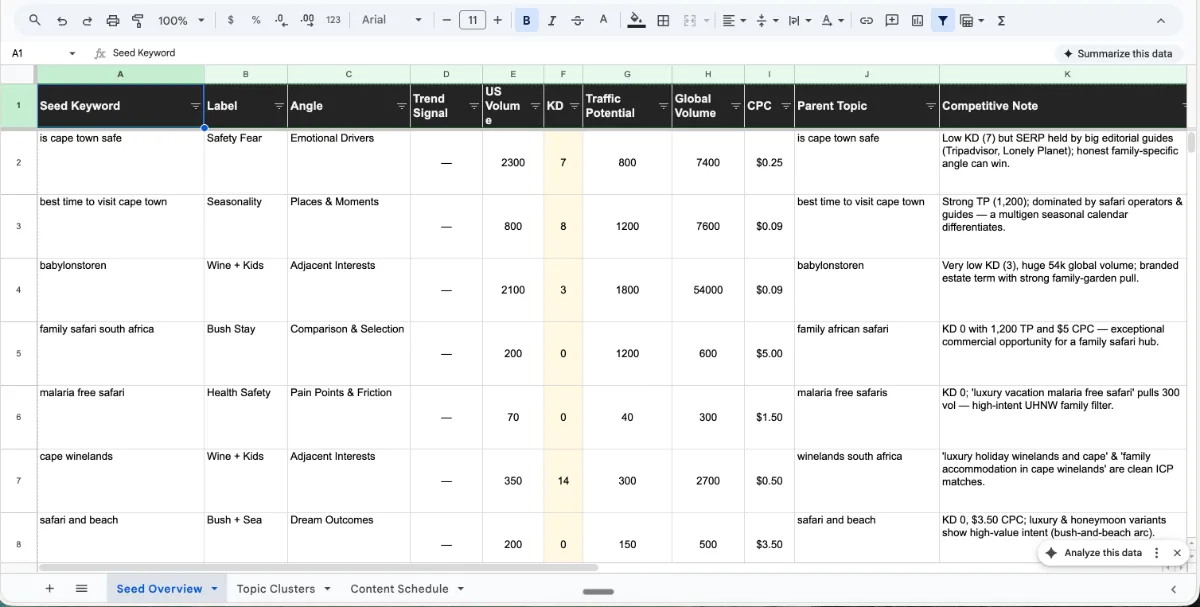
Research is how you stop guessing what to publish, and it only works when it’s grounded in your brand folder.
Without that context, research outputs tend to be generic and easy to copy. With it, the work becomes tied to the brand’s positioning, offers, audience, and actual commercial priorities.
This is the step that decides what is worth writing, what is noise, and where the next content cycle should focus. It turns a pile of possible topics into a smaller list of usable ones.
Key research inputs
- Industry trends: What is changing in the category, what buyers are paying attention to, and which themes are getting more relevant over time.
- Competitor content gaps: What competitors are publishing, what they are missing, and where the brand can cover a topic with a clearer angle.
- Topic clusters: Core themes, supporting subtopics, and how commercial and informational content should connect.
- ICP language: The words, objections, desires, and framing the target audience actually uses when describing the problem.
- Search and AI-citation patterns: How people look for answers across search engines and AI surfaces, and which topics are more likely to earn visibility or mentions.
Strengths
- It is rigorous and repeatable when the same research framework is used each cycle.
- It stays brand-aware because the brand folder feeds the prompts, filters, and topic decisions.
- It helps separate high-value content ideas from filler before time gets spent drafting anything.
- It gives strategy a stronger base because decisions come from patterns, not guesswork.
Weaknesses
- It is still garbage in, garbage out if the brand folder is thin or unclear.
- Raw research outputs need editorial judgment before they become a publishing plan.
- It can create false confidence if teams treat topic volume as the same thing as business relevance.
Who it’s for
This is for brands that have already tried content and stalled because they ran out of ideas, chased weak topics, or kept publishing pieces that never connected back to revenue. It is especially useful when the team feels busy but the content calendar still feels random.
Tools we use
We use Claude Skills for structured research workflows, then pair that with external research tools for market, search, and competitive input. The exact mix can change, but the principle stays the same: brand context goes in first, external signals come in second, and human judgment decides what makes the cut.
3. Strategy: Two Questions That Decide Everything
Overview
Strategy in this system is two questions, asked honestly, every cycle.
That is the filter between good research and useful action. It keeps the team from turning every interesting topic into a priority.
The answers should come from the research step and the brand folder’s ICP definition. If either one is weak, strategy gets noisy fast.
The two questions
- What can we do right now that will bring the most impactful results?: This forces a choice between all possible actions and the few that can move the business soonest or most clearly.
- How can we deliver the best value to our ICP?: This keeps the plan tied to what the audience actually needs, not just what the team wants to publish.
Together, these questions cut through volume and vanity. They turn research into a ranked decision instead of a long idea list.
Strengths
- It forces focus when the content calendar starts filling up with side quests.
- It prevents shiny-object content that looks busy but does not help the ICP.
- It scales well because the same decision framework can be used by one person or a larger team.
- It makes tradeoffs clearer when time, budget, or channel capacity is limited.
Weaknesses
- It is only as good as the ICP definition inside the brand folder.
- It requires the discipline to say no to topics that are interesting but low-impact.
- It can fail if the team confuses short-term ease with real business priority.
Who it’s for
This is for teams that confuse activity with progress. If a team is publishing often but still cannot explain why one topic mattered more than another, this step fixes that.
How AI accelerates it
AI can help map options to ICP fit, content type, and likely business relevance much faster than doing it manually. The final prioritization call is still human, because someone has to decide what matters most right now for the business.
4. Content Orchestration: Omnipresence Across Channels
Overview
In the AI era, one organic channel is not a strategy, orchestrated omnipresence is.
That does not mean posting the same asset everywhere. It means building one core idea, anchoring it on the website, and extending it across the channels where the ICP already spends time.
This is the pattern Marcus-Aurelius Digital runs across its portfolio of luxury brands. The website holds the source asset, and the surrounding channels distribute adapted versions that reinforce the same signal.
Channels we orchestrate
- Website (core asset): The website is the anchor because it holds the main article, landing page, or resource the rest of the system points back to.
- LinkedIn: Best for opinion-led distribution, founder voice, and turning one core idea into shorter professional angles.
- Reddit: Useful when the ICP looks for peer discussion, practical answers, and category-specific conversations.
- Facebook: Still relevant for brands whose audience spends time in groups, local communities, or older social audiences.
- Newsletter: Good for direct distribution to an owned audience without relying on platform reach.
- Other social channels relevant to the ICP: These vary by brand, but the rule stays the same: adapt the idea to the platform instead of copying the same post everywhere.
The website is the base layer, not just another channel. The others are orchestrated extensions that pull from the same source idea while changing format, angle, length, and framing.
Strengths
- Relevance compounds because the same message gets reinforced across multiple surfaces.
- The brand shows up wherever the ICP looks instead of hoping one platform does all the work.
- AI search engines are more likely to see consistent signals when the same core idea appears across owned and third-party surfaces.
- It turns one strong content asset into a wider system instead of a one-and-done post.
Weaknesses
- It requires a real workflow and a strong brand folder before it works well.
- Copy-pasting the same post everywhere is not orchestration, it is lazy distribution.
- It can create more noise than value if the team publishes across channels without adapting to context.
- Cadence matters, so the system breaks when distribution is random.
Who it’s for
This is for brands that are ready to stop relying on a single channel for all organic visibility. It is especially useful for businesses with a clear ICP but scattered publishing habits.
How the orchestration actually works
The process starts with a core piece built from the brand folder, research, and strategy. That source asset usually lives on the website because it is the most stable and reusable home for the idea.
From there, AI helps adapt the core piece into channel-specific versions rather than duplicates. A LinkedIn post may pull out the opinion, a newsletter may frame the takeaway, and a Reddit contribution may answer a narrower use-case question.
The cadence needs to be consistent enough that each channel supports the others. For the full guide, see our organic content system.
5. Data Intelligence: Enriching Live Lead Intake With AI
Overview
Data intelligence is where content orchestration stops being a guess and starts compounding.
The idea is simple: live lead intake from all organic channels gets stored, anonymized, and enriched with AI. The brand folder is the context layer that helps the system interpret what those leads are actually telling you.
This is where the system turns from a publishing machine into a learning loop. Every inbound signal can sharpen what gets researched, prioritized, written, and distributed next.
What data intelligence produces
- Real signals on ICP behavior: Patterns around how prospects arrive, what pages or channels connect first, and how they move through the funnel.
- What they want: Repeated themes in desired outcomes, service interest, or buying intent.
- What blocks them: Objections, hesitations, missing information, or friction points that stop inquiries from turning into deals.
- What offers convert: Clearer patterns around which services, angles, or entry points attract the strongest inbound interest.
Strengths
- It feeds directly back into research, strategy, and orchestration.
- It turns the whole system into a loop instead of a one-way publishing process.
- It helps content decisions reflect real buyer behavior, not just keyword patterns.
- It gives the team a better read on what the audience actually responds to over time.
Weaknesses
- It requires patience because the system needs enough inbound data before patterns become useful.
- It depends on a structured organic funnel, not scattered forms and disconnected channels.
- It needs strong anonymization discipline so sensitive information is handled properly.
- It is weaker when lead capture quality is inconsistent.
Who it’s for
This is for brands with steady inbound demand and a willingness to build the system properly. It is especially useful for businesses that already get leads but do not yet have a clean way to learn from them.
Why the brand folder matters here too
The brand folder gives AI the context it needs to enrich incoming data in a useful way. Without that layer, enrichment becomes generic and detached from the brand’s ICP, offers, and positioning.
That is the connective tissue across the whole system. The same source of truth that shapes content also shapes how lead data gets interpreted, categorized, and fed back into the next cycle.
6. Reporting: Monthly Visibility Across Every Channel

Overview
Reporting is how the system stays honest, and how you decide where to push next month.
Without reporting, content orchestration drifts into opinion and routine. With it, the team can see what is actually gaining traction, what is stalling, and where time should move next.
For Marcus-Aurelius Digital, the primary KPIs are organic traffic and AI search citations. Those two numbers matter because they show both owned visibility and presence across AI-led discovery.
What the monthly report covers
- Organic traffic by channel: Which surfaces are driving visits, and where visibility is growing or flattening.
- AI search citations: Where the brand is being mentioned or surfaced in AI search environments.
- Engagement quality per channel: Which channels bring stronger attention signals, not just raw reach.
- Lead intake volume and quality: How much inbound came in, and whether those leads were relevant or weak.
- Content pieces that drove the most signal: Which articles, posts, or assets contributed the clearest visibility or demand indicators.
Strengths
- It makes tradeoffs visible instead of leaving them to instinct.
- It supports better time and budget allocation across channels and content types.
- It helps separate signal from noise when several channels are active at once.
- It gives the next cycle a clearer starting point.
Weaknesses
- It is only useful if someone actually acts on the findings.
- Vanity metrics are a trap if they distract from visibility, demand, and business relevance.
- It can create false confidence when teams measure output volume instead of outcomes.
- It loses value fast if channel tracking is messy.
Who it’s for
This is for any brand that wants to capitalize on its organic presence and revenue, instead of just publishing and hoping. It matters most once more than one channel is active and tradeoffs start appearing every month.
What we do with the report
We feed the report back into steps 2 and 3. Research gets sharper because it can focus on channels, themes, and formats that are actually producing signal, and strategy gets sharper because priorities are based on evidence from the last cycle.
That is what closes the loop. For the full guide, see our AI content engine.
How to Choose Where to Start With Content Orchestration
You do not need to build all six steps at once. The better move is to start with the pieces that create stable inputs, then add the rest as the system gets cleaner.
Start with the brand folder, always
No other step works properly without the brand folder. It is the base layer that gives AI and humans the same source of truth on voice, offers, ICP, and positioning.
If that document is thin, every downstream step gets weaker. Research becomes generic, orchestration drifts, and reporting tells you less because the inputs were inconsistent from the start.
Pick the channels your ICP actually uses
Do not build for channels just because they are popular. If your buyers live on LinkedIn and direct search, that is where the first version of the system should focus.
A smaller channel mix is usually better at the start. One website anchor plus one or two supporting channels is enough to create signal if the fit is right.
Decide what AI touches and what stays human
AI should handle the heavy repeatable work, especially research support, content adaptation, and data enrichment. Humans should make the strategy calls, check final voice quality, and decide how offers are framed.
That split keeps the system fast without making it generic. It also protects the parts of the process where judgment matters most.
Set a cadence you can actually hold
A weak but consistent cadence beats an ambitious system that collapses after two weeks. Weekly orchestration and monthly reporting is the minimum that usually compounds.
If the cadence is too aggressive, quality drops and the feedback loop breaks. Start with the pace your team can sustain, then increase output once the workflow is stable.
If you want help choosing the right starting point for your setup, grow your organic revenue.
Frequently Asked Questions
What is content orchestration in plain terms?
Content orchestration is connecting brand assets, research, strategy, distribution, data, and reporting into one system instead of running each in isolation.
The point is not just to publish more. It is to make every part of the content process inform the next part, so the system gets sharper over time.
How is content orchestration different from content operations?
Content operations is the process layer, who does what, when, and with which workflow. Content orchestration is the higher-level system that makes sure everyone, and every AI tool, is working from the same playbook.
In practice, operations can exist without orchestration. Orchestration is what makes those operations consistent because the brand folder, strategy, and reporting all feed the same loop.
Do I need AI tools to do content orchestration?
No, you do not need AI tools to start. A clear brand folder and a repeatable cadence get you most of the way.
AI becomes useful when you want to speed up research, adapt content across channels, and enrich data without adding headcount. It helps a lot, but it is not the starting requirement.
How long does it take to set up a brand folder?
For a focused brand, setting up a brand folder can take a weekend to a week.
The timeline depends on how scattered the existing brand information is. If offers, tone, ICP, and positioning are already documented, it moves faster.
Which channels should I orchestrate first?
Start with the channels your ICP already uses and the ones you can maintain consistently. For many brands, that means the website first, then one or two supporting channels.
Do not start with five channels just because they exist. A smaller system with a stable cadence usually beats a wide system that breaks after a month.
How do I measure if content orchestration is working?
The leading indicators are organic traffic and AI search citations. Those show whether the brand is becoming more visible across owned and AI-led discovery surfaces.
After that, look at lead quality, lead volume, and revenue impact. Visibility comes first, then stronger inbound follows if the system is aimed at the right ICP.
Can a small team run this system?
Yes, a small team can run this system. It is built to work for a solo operator or a lean team, especially when AI handles the heavier repeatable tasks.
The key is not team size, it is clarity. If the brand folder is strong, the cadence is realistic, and the reporting loop is active, a small team can run it well.