The Playbook to Get More Traffic From AI Overviews
Get more traffic from AI Overviews by earning the cited link, structuring content AI can extract, and showing up beyond your own site. A practical playbook.

On this page
- Introduction
- What It Takes to Win Traffic From AI Overviews
- Where to Start Based on Your Pages
- Why AI Overview Traffic Is Worth Winning
- Get Cited, Then Earn the Named Link
- Structure Content So AI Can Extract It
- Cover the Full Query Fan-Out
- Win Visibility Beyond Your Own Site
- Refresh and Relink Pages That Already Rank
- Measure the Right Signals, Not the Wrong Ones
- Your Next Move on AI Overview Traffic
- Frequently Asked Questions
Introduction
If you’re running a site and want to get more traffic from ai overviews, the job is to win the citation so the click can land on you. AI Overviews sit at the top of Google and answer first, and organic traffic still compounds from there.
This offensive playbook is for owners and operators watching clicks fall while classic rankings and E-E-A-T still look dialed in. So we treat citation inclusion as the work: earn the named source, then earn the visit with pages Gemini and Google can extract as a clean answer.
What It Takes to Win Traffic From AI Overviews
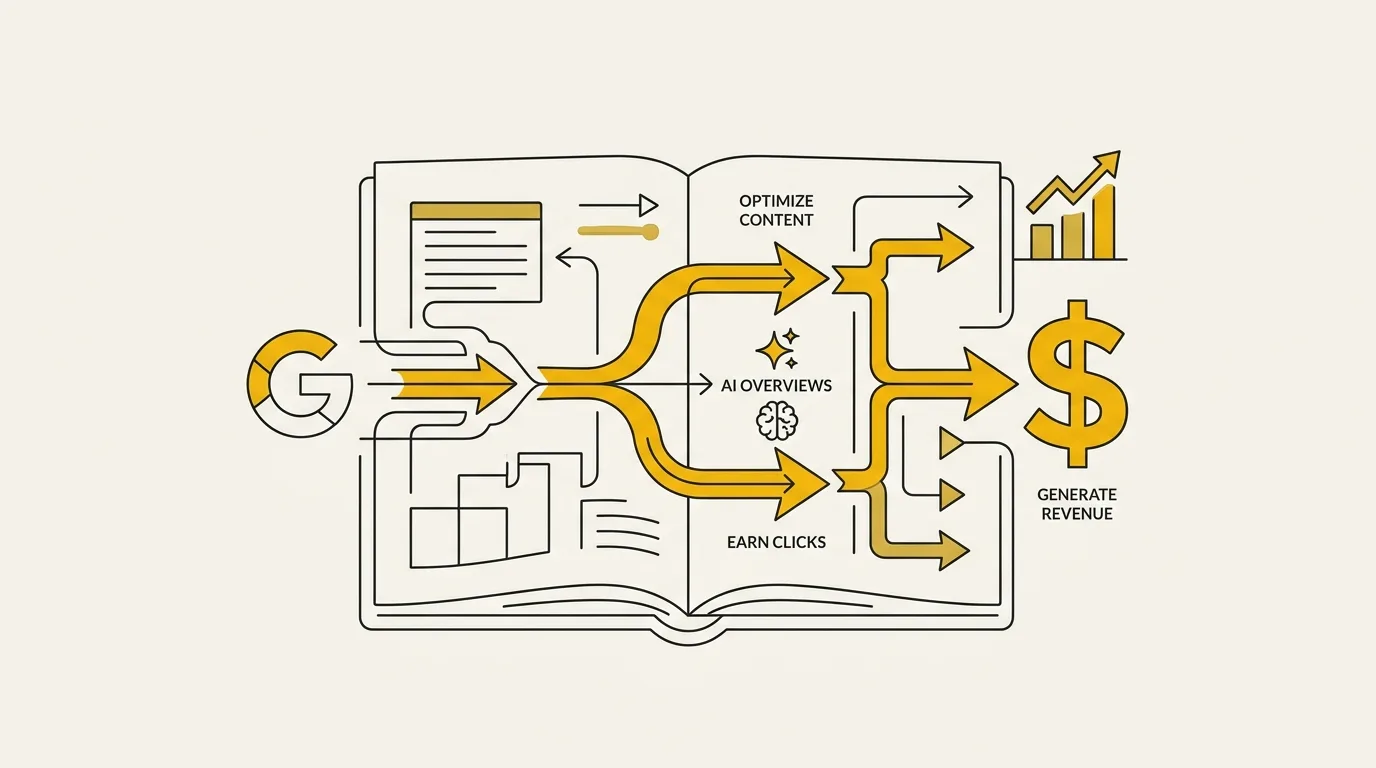
Winning AI Overviews traffic takes five plays: earn the cited, linked mention, structure content for extraction, cover the query fan-out, show up beyond your own site, and refresh pages that already rank.
Run them in that order. Google AI Overviews expand one query into related sub-queries and write a cited summary, so the linked mention has to land first. Extraction, fan-out coverage, off-site proof, and a refresh on ranking pages then keep you eligible when someone wants the source (that’s when the clicks happen).
Where to Start Based on Your Pages
Start with ranking pages where classic visibility is strong and AI Overview pickup is still catching up. So split the rest as already-cited pages, then work the other situations in order. Each row is an ai overview optimization starting point for the queries those URLs already touch.
| Your situation | Start here | Effort | Time to payoff |
|---|---|---|---|
| Ranking pages, AI still catching up | Structure for extraction | Moderate | Fast |
| Cited pages, CTR still sliding | Earn the named link | Focused | Medium |
| Thin or generic pages | Cover the query fan-out | Heavier | Slow |
| Strong site, off-site still open | Show up beyond your site | Ongoing | Medium |
| Older ranking pages due a refresh | Refresh and relink | Light | Fast |
Why AI Overview Traffic Is Worth Winning
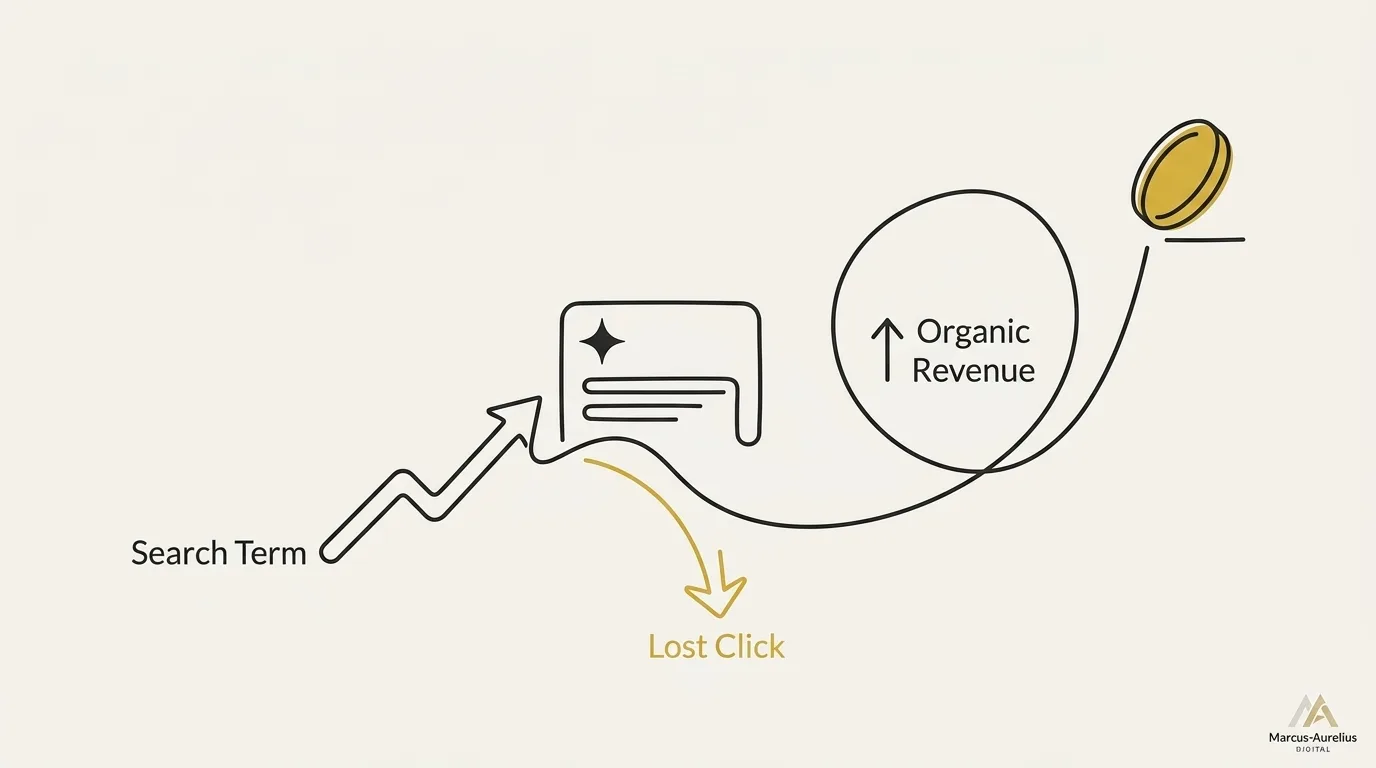
AI Overview clicks arrive pre-qualified: the reader already has the summary, then comes to you for the booking, the hire, or the enquiry. That visit is the one worth winning, because organic search traffic that lands this way already carries intent. A common pattern is the dark funnel: you get cited in the answer while CTR falls, and in B2B those citations tend to show up later in the journey.
Look, AI Overviews absorb the informational queries, and the commercial move still needs a provider who can close it. We sent a luxury travel client their June SEO report with sessions at a yearly low, and 30% of all the CRM leads they had ever captured landed in that one month (their best lead month on record). So build for the action the summary leaves with you.
Get Cited, Then Earn the Named Link
The work that pays is the named, linked citation, because that is the state that moves a reader. A page can sit in the model’s research, even get used as a source, while the overview still names another brand.
In one tracked experiment, AI cited a brand’s own page 43% of the time and still skipped mentioning that brand, using the page as research, then naming someone else on the same list. The cited page did the research work, and the other brand took the named slot.
Mentioned, selected, and cited explained
Three states sit on the ladder to get cited in AI Overviews: mentioned, selected, and cited with a named link. Mentioned means your page is in the grounding set, the material the model considered for the query, and that presence can stop in the research pile.
Selected means the overview uses your page to support a claim, so you show up as a cited source while the brand name stays off the sentence the reader sees. Cited with a named link means the overview names you and attaches a URL, and that linked mention is the visibility that moves a reader.
Earn the link that passes a click
You earn the link that passes a click by making the brand easy to name: clear authorship, a quotable answer, and entity clarity on the page. Authorship means the page shows who wrote it and which organization stands behind it, so the model can attach a name it already trusts.
The quotable line is a self-contained sentence the overview can lift, and entity clarity means the brand name and the page title match the way a searcher would name you. So put the work on queries you obviously belong on, once enough trust already exists that the model believes you when you show up.
Structure Content So AI Can Extract It
AI cites the clean claim it can lift, so structure the page so a model can grab it in one pass. A common pattern is extractability: the first lines under a heading state the claim, then headings, tables, and decision rules make the rest scannable. That work is the on-page half of AI overview optimization.
Put the claim in the first lines under each heading so a model can quote it in one grab. Make that sentence self-contained, then bring in the proof.
Split the page into short H2s, H3s, and lists so each block maps to one question. That boundary is what makes a passage easy to lift.
Add comparison tables and explicit if-then rules a model can lift as a complete sentence. Choose X when Y is the line that carries the constraint.
Cap each extractable block around forty words so the citation stays tight and complete. Write to the question until it is covered, then stop.
Lead with a direct answer up top
Put the claim in the opening lines under every H2 and H3, as a self-contained sentence ChatGPT, Perplexity, Gemini, or Google AI mode can quote. Same habit that wins featured snippets: one declarative sentence, then the proof.
So the model can lift that line on its own. Write it so it still makes sense with the heading stripped.
Break content into scannable sections
Split the page into short H2s and H3s that each map to one follow-up question. Give each block a single job, then stop.
Headings, bullets, and FAQ-style blocks give the model clear passage boundaries. A list is for options or steps. A short paragraph is for the claim that sits above it.
Add comparison tables and decision rules
Add a comparison table when the reader is choosing, and write the rule as a sentence the model can copy. Choose X when Y is the line that gets cited, because it carries the constraint.
Name the threshold and who each option suits. Practitioner pages that spell tradeoffs and evidence-backed specifics are the ones models quote.
Keep each answer around forty words
Keep each extractable block around forty words so the citation is a complete lift. Write to the question until it is covered, then stop.
Look, word count is a vanity metric. The average cited page is under 1,300 words, and more than half are under 1,000.
Get in touch to see our organic growth system applied to pages like this.
Cover the Full Query Fan-Out
Answering the sub-questions behind a query is what earns the citation, because query fan-out is how Google splits a search into those branches and cites the pages that answer them. So we use a GSC-driven topical map from live Search Console data to cover the queries already showing around the entity, with each exact-match query flagged to update or create new and a brief scoped to the brand.
We map that fan-out across a page or a SILO cluster. The pillar holds the main intent, and supporting pieces cover the how-to, listicle, and comparison queries that branch off it. This is an extension of SEO: same entity work, same citation-ready pages, now applied to multi-turn phrasing as well as classic keywords.
Win Visibility Beyond Your Own Site
The zero-click era killed the bet that publishing only on your own site would keep sending people. Answer engines pull from community and video sources, so syndicate those answers onto Reddit, YouTube, and the forums your buyers already read, where off-site credibility sits in the mix.
Keep the blog, then put that content on LinkedIn and Facebook as well, and convert the attention into a newsletter list you own. Directory-blast and get-cited-everywhere checklists are short-lived, and mechanical GEO gets arbitraged the way older spam tactics did. Real visibility is earned where models already look.
Refresh and Relink Pages That Already Rank
Refreshing pages that already rank is the fastest-payoff play. A common pattern is older URLs responding faster in both ranking and AI reuse. Update the structure, refresh the content with current evidence, and add internal linking from your strongest URLs.
Here’s the thing: internal links help where they point. A page’s authority comes from inbound links, so pull from your highest-authority pages and drop a contextual link into the ones already showing in search with weak clicks. That inbound lift can improve usefulness and AI extractability, and the full workflow for how to recover from an ai overviews traffic drop covers the rest of the sequence.
Measure the Right Signals, Not the Wrong Ones
We track citation count, mention frequency, sentiment, and brand lift alongside clicks, because most analytics setups mix AI Overview sessions into ordinary organic in GA4 and Google Search Console. Click data shows what landed on the site, while AI visibility lives in how often ChatGPT, Perplexity, Gemini, and Google AI mode name you. Across 75,000 brands, YouTube mentions predicted whether an AI named the brand at a 0.74 correlation.
So keep a running citation log and spot-check a set of high-volume queries by hand. It’s a reality check, because tools can disagree on whether an overview fired, and attribution stays probabilistic. Build the log first, then use how to track traffic from ai overviews for the full method.
Your Next Move on AI Overview Traffic
Your next move is to pick one play and run it on the pages you already have. Keep going until the named citation and the click land on the same URL, because that is how AI Overview traffic actually arrives.
- Thin pages start with structure: lead the content with a direct answer the model can lift.
- Strong ranking pages start with the named, linked citation, so the overview sends the reader to you for the booking or the inquiry.
- Stable sites start with syndication and a refresh of URLs that already rank, so visibility compounds on-site and off-site.
If you want that work as a managed (hands-off) build or an owned (buyout) system, get in touch and we’ll scope it on a call. And we’ll start from the pages you already rank, then tell you which play to run first.
Frequently Asked Questions
Can you actually get traffic from AI Overviews?
Yes, AI Overviews send traffic when the module names you with a linked citation, and when the reader still needs the booking, the hire, or the inquiry after the summary. Answer engines handle the first pass, and you win the visit that comes next.
Does getting cited in an AI Overview send clicks?
A named, linked citation is what sends clicks. The overview names your brand and the link is the path the reader uses to reach your page.
How is optimizing for AI Overviews different from regular SEO?
Optimizing for AI Overviews is an extension of regular SEO, with extra weight on entity clarity and extractability. Rankings and overview citations can move independently, so keep them as separate lines in reporting. You keep the same fundamentals and add structure a model can lift in one pass.
How do I know if my pages are cited in AI Overviews?
Search your highest-value queries in an incognito window and check whether the overview names your URL. Google Search Console folds AI feature traffic into the Web search type in the Performance report, so use that export as your list, then verify the live SERP.
Should I keep creating informational content?
Yes, keep creating informational content because those pages build topical authority and give answer engines extractable claims they can cite. Keep them current, structured, and tied to the commercial next step those readers take.
How do I baseline my AI mentions and track change?
A practical way to baseline mentions is to run the same buyer questions through ChatGPT, Perplexity, Gemini, and Google AI mode, then re-test to quantify change. Record whether you were mentioned and whether the named link appeared, each pass, so the comparison stays clean.