Google AI Overviews Impact on Organic Traffic: Separating Real Loss From Panic
Google AI overviews impact on organic traffic is real but uneven: see which queries lose clicks, which still convert, and how to spot AI losses vs ranking

On this page
- Introduction
- What AI Overviews Actually Do to Organic Clicks
- Which Queries Lose Traffic First
- Why Strong Rankings No Longer Protect Your Traffic
- How to Tell If AI Overviews Caused Your Drop
- The Attribution Gap: Cited Without Measurable Traffic
- What Still Earns Clicks and Citations
- What This Means for Your Next Move
- Frequently Asked Questions
Introduction
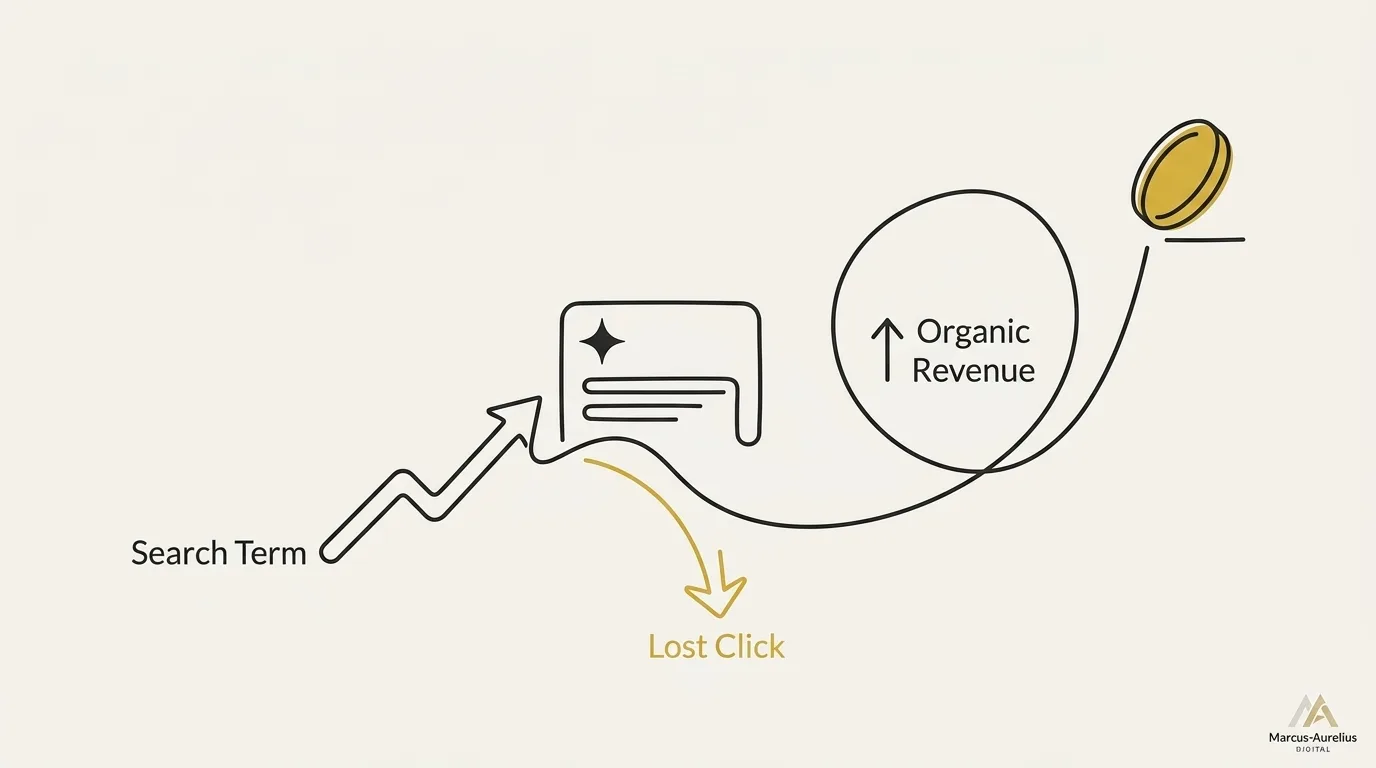
The google ai overviews impact on organic traffic shows up as missing clicks while enquiries still arrive. The loss is real, and it hits some queries harder than others. Google now answers the research questions that used to send a visit, so those questions resolve as zero-click searches while founders and operators watch organic sessions slide.
Here’s the thing: we sent a luxury travel client a June report with traffic at a yearly low. So that same month, 30% of all the CRM leads they had ever captured arrived (the best lead month on record). This page separates which traffic drops, which still holds, and how to tell an AI-caused drop from a ranking or demand shift.
What AI Overviews Actually Do to Organic Clicks
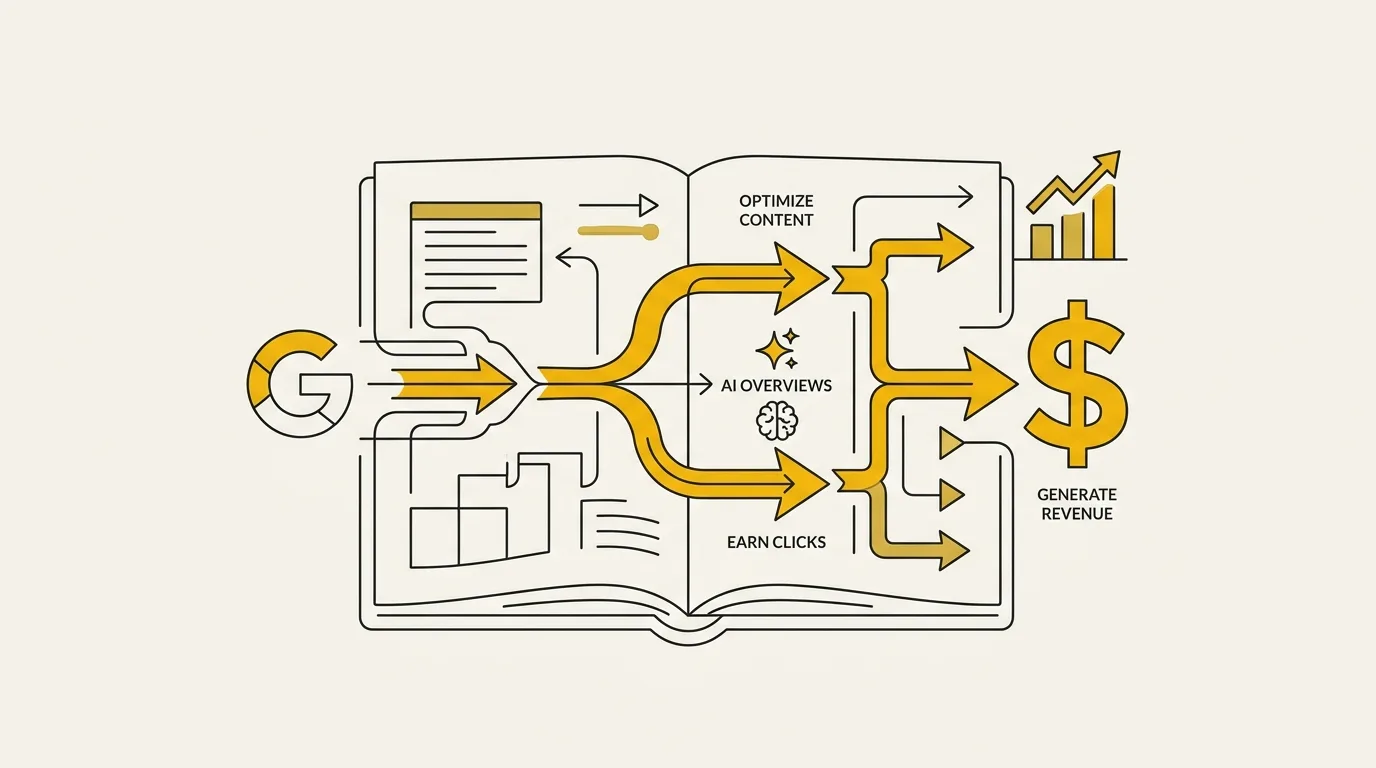
AI Overviews cut clicks mainly on informational queries while leaving transactional and comparison queries far less affected. Recent field studies from Seer Interactive and Semrush document a sharp organic CTR decline on queries that trigger an AI Overview.
Rankings can stay put while CTR falls (even when the listing still looks strong). A common pattern is a solid organic position with weaker revenue impact, because the overview already answered the query. And that is how zero-click searches show up: visibility holds, visits drop.
The rest of this page separates three losses:
- Informational-query visits that now end on the SERP
- Strong rankings paired with a collapsing CTR
- An overview citation that stays a mention, with sessions unchanged
For organic search that still produces qualified inquiries, get in touch.
Which Queries Lose Traffic First
Informational queries, especially how-to and what-is, lose clicks first, because Google can finish the answer in the Overview. Comparison and commercial searches still pull a click when someone needs depth, a side-by-side, or a booking.
So check your mix of queries against the table. The share sitting in zero-click searches is the share you should expect to move first.
| Query type | AI Overview likelihood | Click impact | Why |
|---|---|---|---|
| Informational / how-to / what-is | High | Steep click loss | Google finishes the answer on the results page |
| Comparison / X vs Y | Moderate | Moderate | Readers still open the page for depth and proof |
| Transactional / buy / near me | Low | Low | The buy, book, or visit still happens on your site |
| Navigational / branded | Minimal | Minimal | Brand-name searches still land on the official URL |
Why Strong Rankings No Longer Protect Your Traffic
A #1 ranking is worth 58% less the moment an Overview sits above the blue links, and position ten loses 19% of its clicks in the same situation. Your rank can still look strong while the buying decision happens in the box, before anyone reaches your URL.
The decoupling of impressions and clicks
The diagnostic pattern is a widening crocodile gap: impressions hold or climb while clicks fall. The Overview finishes the answer on the results page, so it’s common to see the impression line keep rising as the box does the work.
So position is a weak predictor of revenue, and field testing suggests AI Overviews can still cite a page after its organic rankings have slipped. Site-wide average CTR and average position are near-meaningless as headline numbers. The useful read is query-by-query, page-by-page, over a 3-month window (a swing from 4 to 14 and back is often a live CTR test running in public).
How to Tell If AI Overviews Caused Your Drop
The signal that points to AI Overviews is stable rankings and impressions with falling CTR on informational queries. The URL still ranks, and the Overview finishes the research question on the results page, so CTR drops while average position holds.
That’s the first filter. Then check ranking movement, demand, seasonality, and tracking gaps before you treat the drop as Overview-led.
Other causes that mimic an AI Overviews drop
Several other issues produce a similar-looking traffic fall. Read the matching first check against the same date range in your data so you keep the Overview diagnosis for the pattern that remains.
- Ranking or inclusion criteria changes appear as a slipping average position, with impressions and clicks falling together. Check the position trend on those URLs first.
- Reduced search demand appears as impressions and clicks falling together while position holds. Check Google Trends on the query cluster.
- Seasonality appears as a drop that repeats in the same weeks year over year. Check the prior-year window for the same queries.
- Tracking and attribution errors appear as Search Console clicks holding while GA4 sessions fall. Audit the GA4 tag and UTM coverage first.
GA4’s AI chatbot channel records someone asking ChatGPT a question and clicking through to your site. The dominant pattern is a brand mention in ChatGPT, Perplexity, Gemini, or Google AI mode, then a branded Google visit later, which lands as organic branded search. Treat that channel as a signal when you read attribution.
A quick diagnostic sequence
Compare CTR on queries you have confirmed trigger an Overview against similar queries that still show standard results. If the Overview set loses CTR while the twins hold and rankings stay flat, the Overview caused the drop.
- Open Performance in google search console and restrict the view to informational URLs whose average position stayed flat through the drop.
- In incognito, confirm which of those searches trigger an Overview, and pair each with a close query that still shows standard results.
- Pull CTR and clicks for both groups over the same date range. Overview-led loss shows as CTR falling on the trigger group while the twins hold.
- If impressions and clicks fall in both groups, go back to the demand and ranking checks above.
Generative AI visibility reporting stays impressions-only and can lump AI Overviews with Google AI mode, so you still diagnose from query CTR. Query-level CTR data is enough to name the cause. The working notes on how to track traffic from ai overviews cover citation and channel setup after this call.
The Attribution Gap: Cited Without Measurable Traffic
Being cited inside an AI answer can move demand while organic sessions stay flat, because answer engines keep the reader on their own surface. Clicks that do come through from ChatGPT, Perplexity, Gemini, or Google AI mode land as direct (empty referrer), so ROI models built on organic sessions miss the path.
A page can sit in the grounding data, get pulled into the answers, and still leave reporting untouched. Treat these as three separate outcomes:
- Mention presence: your URL sits in the material the model considered for that query.
- Citation or recommendation: the answer uses your page to support a claim, or names a pick.
- A named link: the answer names you and attaches a URL the reader can follow.
The named link is the outcome that can produce a session you can count. Grounding and a citation stay on the answer surface.
In one tracked experiment, AI cited a company’s own page 43% of the time and used that page as research, then named someone else on the same list. A citation is the research the model consumed, and a recommendation is the brand name that appears in the answer.
And teams now run scorecards that track organic sessions and conversions next to AI outcomes, because clients still want numbers when the impact stays off the click path. Those scorecards count AI citations and brand mentions alongside referral traffic from the same period.
What Still Earns Clicks and Citations
Original data, case studies with real metrics, named expert perspective, and comparison or transactional pages still earn both clicks and AI citations. The reader still needs a side-by-side, a booking path, or a figure only you measured, so those URLs keep earning the visit.
Organic is the compounding channel, and we feed it with AI-orchestrated organic content at scale, brand voice injected and proprietary data fed in. We built an AI-led organic system for a luxury real estate brand that went from barely visible to highly present across search and AI discovery.
And the practical move is to get more traffic from AI Overviews with pages that engines can lift in one pass. Depth still lives on the comparison and transactional URLs that close the inquiry.
Content formats AI tends to extract
Answer engines pull a concise declarative opening, then structured lists, tables, labeled sections, and FAQs. In my experience, visibility across ChatGPT, Perplexity, Gemini, and Google AI mode tracks that extractable shape more than rank or length.
Word count is a vanity metric: the average cited page is under 1,300 words, and more than half are under 1,000. AI cites the answer, so put the finding first and let the rest of the content support it in lists and tables.
What This Means for Your Next Move
Clicks falling on informational queries while rank stays stable is the AI Overviews pattern. Impressions falling with them points to rankings or demand first, and that is the order you work in.
So organic is the channel that compounds, and organic traffic still builds equity when the Overview takes some of the clicks. The next move is recovery on the URLs that still convert, plus a clean read of ai overviews traffic across the site. If you want that scoped against your queries, get in touch and we’ll jump on a call.
Frequently Asked Questions
Do AI Overviews actually reduce organic traffic?
AI Overviews reduce organic traffic on informational queries because Google answers the research question on the results page. The URL can still rank, and the reader already has the short answer, so fewer people open the listing. Comparison and commercial searches still send visits when someone needs a booking path or original figures.
Why are my impressions up but my clicks down?
You’re ranking in a stable position while an Overview sits on the query. Google records the impression twice (once in the Overview and once in the blue links) while clicks fall even though rank holds. That pattern shows up as rising impressions and a falling CTR on how-to and what-is terms, with the research step finishing in the box above the listing.
Can I see AI Overview traffic in Google Search Console?
As of June 2025, Overview visits sit in your Web search totals in Google Search Console, mixed with classic organic results. Estimate the Overview effect by watching query clusters where impressions rise and CTR drops at a stable or top position. Compare that cluster with similar queries that stay in classic results, so you can see the gap in click share.
Does being cited in an AI Overview bring me traffic?
A linked citation can send a visit. A brand mention in the AI text is exposure on the results page. Those visits arrive inside normal organic sessions, because the summary layer shares the same Web totals. Report mention presence and citation presence as two different outcomes.
Which content is most affected by AI Overviews?
Informational and how-to pages are the most exposed to AI Overviews, because the box can finish the answer on the search page. What-is queries follow the same pattern. The reader still opens a listing when they need a booking path or a figure they can act on.
Do strong rankings still protect my traffic?
Position still gets you seen, and visit volume now follows whether an Overview sits above the blue links. A number one listing can lose a large share of its sessions the moment that box appears, even while average position stays strong. Treat rank as visibility, then check CTR on the informational cluster to see if the Overview is taking the session.